

Hume Band 2.0 vs 1.0: Should You Upgrade? The Honest Comparison
A Physiotherapist Who Wore the Original for a Full Year Breaks Down Every Real Hume Band 2.0 vs 1.0 Difference
If you own the original Hume Band and you are wondering whether the new Hume Band 2.0 is worth the upgrade, this Hume Band 2.0 vs 1.0 comparison is written for you. Not for first-time buyers, not for casual shoppers, but for someone who has lived with the v1 on their wrist and wants to know if the 2.0 is a real evolution or a marketing refresh.
Short answer: for most v1 owners, the Hume Band 2.0 is genuinely worth upgrading to. The five concrete hardware and software improvements (doubled battery, Blood Pressure Insights, UltraLux strap, cleaner signal processing, nutrition tracking arriving June 2026) are not marketing filler. They change the way the device fits into daily life. There are a few specific v1 owners who should stay put, and we will walk through who.
As a licensed physiotherapist who has worn the original Hume Band for a full year of daily use, I want to give you something most Hume Band 2.0 vs 1.0 comparisons skip: the real-world implications of each spec sheet change, framed for someone who already has a device on their wrist and has had time to develop strong opinions about its real strengths and limitations.
Hume Band 2.0 vs 1.0: Should You Upgrade in 30 Seconds
✅ Yes, Upgrade If
- You care about cardiovascular health and want continuous blood pressure trend visibility
- The v1’s 7-day battery caused you to miss recovery data on charge days
- You found the original SuperKnit strap uncomfortable for sleep or skin-sensitive wear
- You are a Hume Premium subscriber, the free upgrade-every-2-years benefit makes this essentially included
- You wear the device 24/7 and rely on its insights for daily decisions
⚠️ Skip the Upgrade If
- You rarely wear the v1, the 2.0 will not change your habits
- You bought the v1 less than 3 months ago and are still in your baseline calibration window
- You have no interest in blood pressure tracking (the marquee 2.0 feature)
- You are perfectly comfortable with the SuperKnit strap and your v1 battery routine
- You are saving for something else, the v1 still works and Hume continues to support it
The 5 Real Differences Between the Hume Band 2.0 and the 1.0
Before we get into what each change actually means, here is the side-by-side spec sheet. Five things genuinely changed between the original Hume Band and the 2.0. Everything else stayed the same on the surface, but as you will see in section 5, “same on the surface” is hiding the most interesting part of the upgrade story.
| Feature | Hume Band 1.0 | Hume Band 2.0 |
|---|---|---|
| Battery Life | 7 days | 14 days + 5-minute quick-chargeDOUBLED |
| Strap Material | SuperKnit fabric (durable, but firm) | UltraLux soft-touch fabricUPGRADED |
| Blood Pressure Tracking | Not available | Directional trend trackingNEW |
| Sensor Module | 5 LEDs + 4 photodiodes | 5 LEDs + 4 photodiodes (same hardware) |
| Signal Processing | v1 baseline accuracy | Improved signal cleanup, cleaner HRV / sleep dataUPGRADED |
| Chronic Illness Detection | Available (early signal) | Same metric, sharper AI insights from cleaner dataREFINED |
| Pace of Aging | Available | Same metric, sharper AI insights from cleaner dataREFINED |
| Biological Age | Available | Same metric, sharper AI insights from cleaner dataREFINED |
| Nutrition Tracking | Not available | Arriving June 2026 (app update)NEW |
| Hume Premium | $8.99/month, optional | $8.99/month, optional, free band upgrade every 2 years |
| Water Resistance | IP68, 1m for 2 hours | IP68, 1m for 2 hours (same) |
| App | Hume Health (shared with 2.0) | Hume Health (shared with 1.0, your data carries over) |
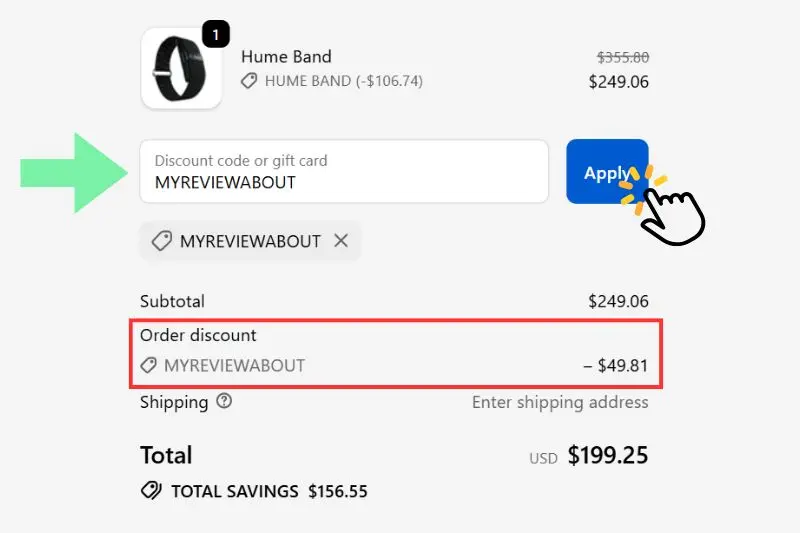
| Retail Price | $249 at launch | $356 retail, $199 with code MYREVIEWABOUT |
Notice something important in that table: the sensor module hardware is identical. Same 5 LEDs, same 4 photodiodes. The improved accuracy on the 2.0 does not come from new physical sensors, it comes from refined signal processing that filters noise more aggressively before the data reaches the AI scoring layer. That is a meaningful distinction, and we will get to why in section 5.
Hume Band 2.0 vs 1.0: What Each Upgrade Actually Changes for a v1 Owner
A spec table is one thing. What matters is what each upgrade does to your daily experience with the device. Here is the honest breakdown, framed for someone who has been wearing the v1.
🔋 1. The Doubled Battery Changes Your Relationship With the Device
If you have lived with the v1’s 7-day battery, you already know the silent cost. Every charging cycle creates a data gap. Sleep nights vanish, HRV trend lines develop holes, and the Chronic Illness Detection algorithm has fewer continuous data points to work with. Over a full year of v1 wear, I noticed that my charge days consistently disrupted my Metabolic Momentum scoring for the following 24 to 48 hours, because the rolling baseline had a fresh gap to compensate for. The peer-reviewed literature on continuous wearable monitoring consistently shows that signal continuity matters more than peak signal quality when it comes to trend reliability, which is exactly the problem the 2.0’s doubled battery solves.
The 2.0’s 14-day battery cuts those data gaps in half. Even more practical, the new 5-minute quick-charge giving a full day of tracking means you can top up the device while you shower. No more sleeping naked-wristed for a night because you forgot to charge. From a continuous-monitoring philosophy standpoint, this is the single change that has the most compounding effect on data quality over months of wear.
🧵 2. The UltraLux Strap Solves the One Real Comfort Issue on the v1
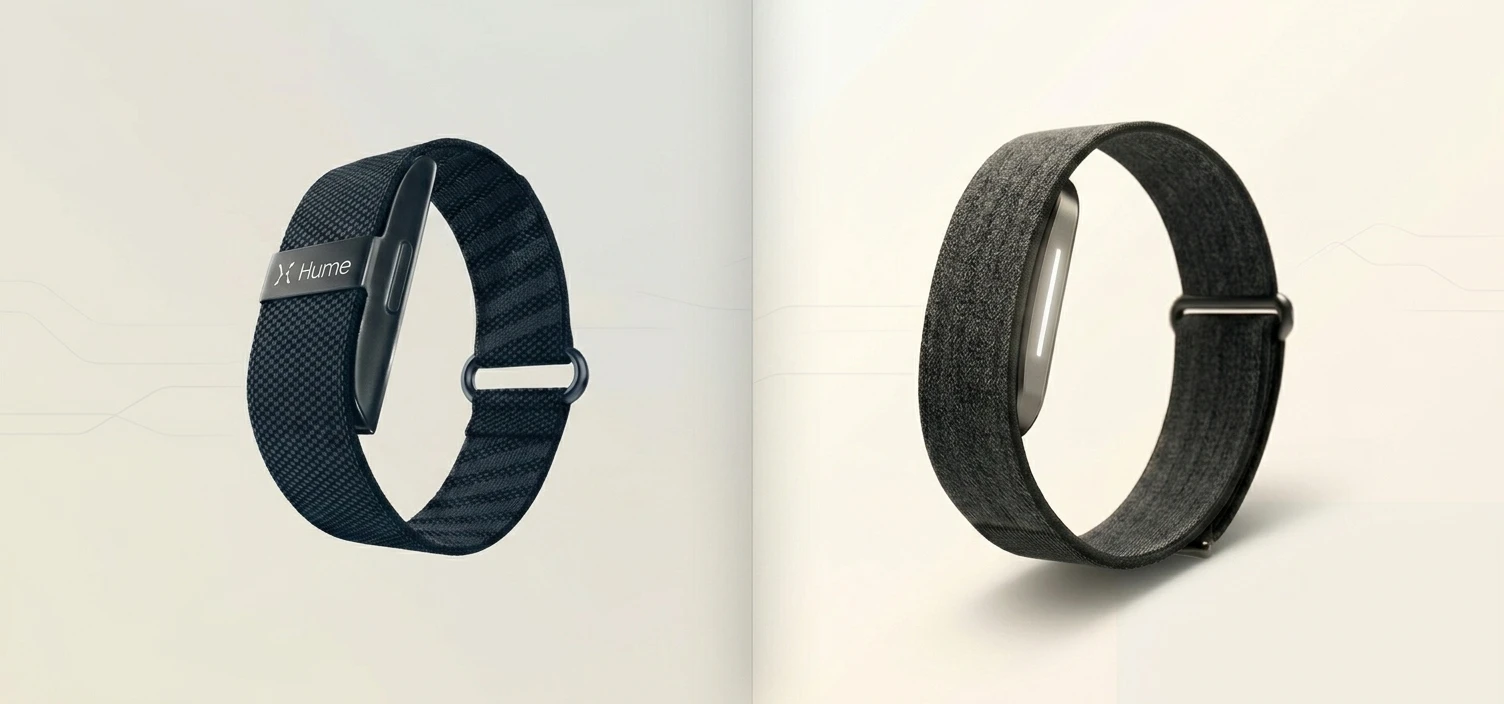
The original Hume Band shipped with a SuperKnit fabric strap, which was already a significant step up from the silicone bands most fitness wearables use (Whoop being the obvious culprit there). But after twelve months of 24/7 wear, the SuperKnit’s firmness became noticeable, especially during sleep. I ended up sourcing a third-party replacement strap on Amazon to make continuous wear genuinely comfortable, and I was not alone in this. Plenty of long-term v1 users reported the same workaround.
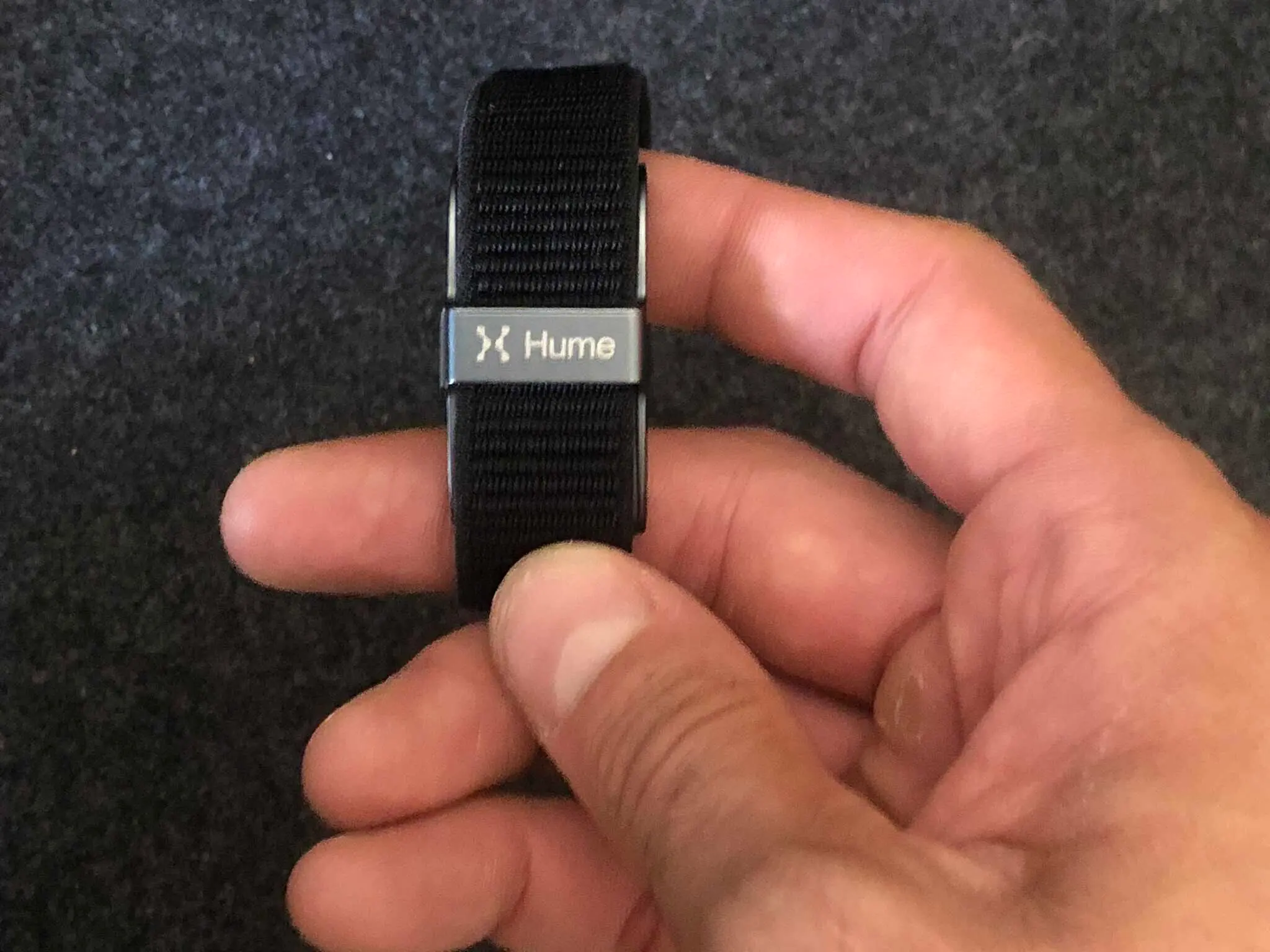
The new UltraLux soft-touch fabric on the 2.0 is engineered specifically for continuous wear. On paper that reads like marketing, in practice it solves the most consistent piece of feedback from v1 owners. If you are someone who took the v1 off at night because it felt too firm under the wrist, the strap upgrade alone may justify the move to the 2.0, because a device you only wear 16 hours a day cannot track the most valuable 8 (sleep).
🩺 3. Blood Pressure Insights Is the Marquee New Feature for a Reason
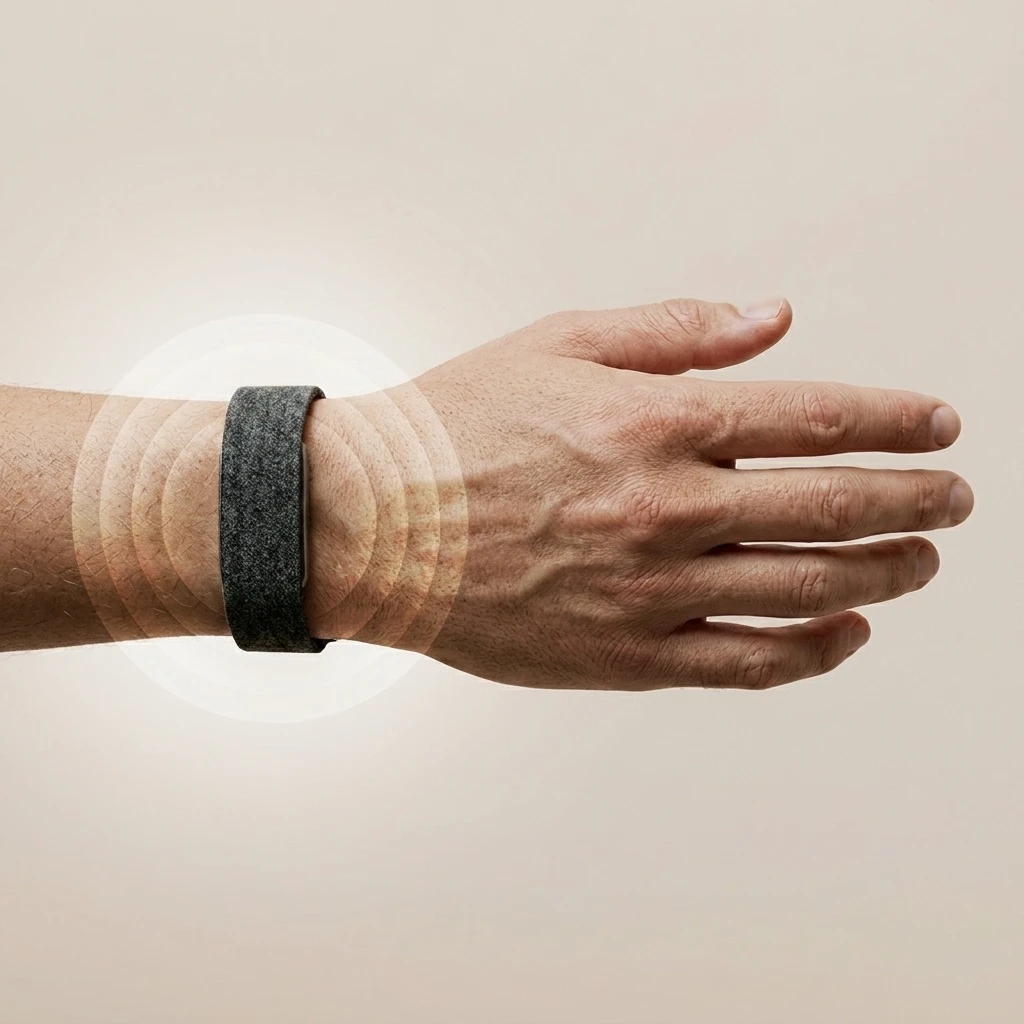
This is the single largest functional addition. The Hume Band 1.0 did not track blood pressure at all. The 2.0 introduces Blood Pressure Insights, a directional trend tracker that samples optical signals from your radial artery and surfaces patterns over hours, days, and weeks. It is not a cuff replacement (no wrist wearable is, that would require occluding an artery), but it is something different and arguably more useful for long-term cardiovascular risk awareness: a longitudinal view of how your blood pressure is actually behaving in response to your real life. The peer-reviewed research on PPG-based blood pressure estimation shows this approach can reliably detect directional trends even when absolute readings remain less accurate than cuff measurements, which is exactly the use case the Hume Band 2.0 is calibrated for.
For a v1 owner over 35 who is starting to care about cardiovascular health, this single feature is a real reason to upgrade. The Hume Band 2.0 lets you see whether your blood pressure correlates with sleep quality, alcohol intake, training load, work stress, and weight changes, all on the same dashboard, all without buying a separate cuff monitor and remembering to use it. That kind of cross-variable visibility is what the Hume Band has always promised, and the 2.0 finally completes the cardiovascular side of that promise.
If you want the full clinical context on what Blood Pressure Insights does (and does not) measure, the dedicated deep-dive lives in the full Hume Band 2.0 review.
🧪 4. Cleaner Signal Processing Quietly Improves Every Other Metric
This is the upgrade most reviews underweight, and it is actually the most important one. The Hume Band 2.0 uses the same 5 LEDs and 4 photodiodes as the v1. The hardware sensors did not change. What changed is the signal processing pipeline that sits between the raw optical data and the AI scoring layer.
On the v1, the raw data was already good. The 2.0’s improved processing filters noise more aggressively before the data reaches the algorithm. Cleaner inputs equal cleaner outputs. The practical result is HRV trends with fewer false-positive sleep arousals, more stable Heart Resilience scoring across the week, and (this is the key part) AI coaching that finally feels confident enough to give specific, actionable nudges instead of hedged generalities.
If you ever used your v1 and felt that the Metabolic Momentum scoring jumped around in ways that did not match how you actually felt, the signal upgrade addresses exactly that. Cleaner data means more trustworthy trends, which means the device actually delivers on the longevity promise instead of generating numbers you eventually stop trusting.
🥗 5. Nutrition Tracking Closes the Last Big Input Gap (June 2026)
The Hume Band 2.0 will ship with nutrition tracking as a Hume Health app update in June 2026. This was never available on the v1 and is not technically available on the 2.0 yet either at the moment of writing, but the feature is committed and the architecture is being built for it.
What this enables is the single thing the Hume ecosystem has always been missing: the ability to correlate inputs (what you ate, when you ate it) with outputs (HRV, sleep architecture, Metabolic Momentum, blood pressure trends). Once you can see that a late dinner consistently drops your deep sleep by 18 minutes, or that a high-sodium meal moves your blood pressure trend the next day, the device finally becomes the closed-loop feedback system its design has always implied.
Worth being honest: this is the only one of the five upgrades that is not available on day one. If your decision hinges entirely on nutrition tracking, you can wait until June 2026 to confirm the feature ships well. If your decision is anchored to the other four upgrades, nutrition tracking is a bonus arriving a few weeks after your purchase, and it makes the broader Hume Band 2.0 vs 1.0 comparison even more lopsided in the 2.0’s favor.
Same Metrics, Sharper Insights: What the v2 Quality Bump Actually Means
Chronic Illness Detection, Pace of Aging, Biological Age, Heart Resilience: all four were on the v1. So what changed?
Here is the part of the upgrade story that most reviewers skip entirely. Several of the Hume Band 2.0’s headline metrics (Chronic Illness Detection, Pace of Aging, Biological Age, Heart Resilience, Metabolic Capacity, Metabolic Momentum) were already on the v1. The marketing pages do not say “new” next to these metrics, and the spec sheet shows them as unchanged. So a quick comparison would conclude that nothing actually got better on these features.
That conclusion misses the most interesting part of the v2 upgrade. The metrics did not change. The data quality flowing into them did. And in an AI-driven scoring system, cleaner data quietly transforms what the algorithm can actually do.
Why cleaner input data changes AI output quality
An AI coaching layer like Hume Health’s is essentially a pattern-matching engine sitting on top of a continuous biomarker stream. The cleaner and more consistent the input stream, the more confidently the engine can flag patterns. On the v1, the algorithm had to hedge: noisy HRV readings, scattered sleep wake events, and signal artifacts forced the coaching to stay general (“you may benefit from more recovery this week”) because the underlying confidence was not high enough to be specific. The peer-reviewed literature on HRV and autonomic function is consistent on this point: signal artifact and noise are the biggest threats to HRV interpretation reliability, and any improvement in signal cleanup translates directly into more trustworthy downstream metrics.
The Hume Band 2.0’s improved signal processing reduces that noise floor. Same metrics, but the AI now has a cleaner picture of what is actually happening in your body. The practical consequences:
The compounding effect over months of wear
Here is what this looks like over a full quarter of wear. On the v1, you would learn things about your body. On the 2.0, you would learn the same things, but the AI would be willing to commit to specific recommendations sooner, with higher confidence, with fewer hedged “we are not sure yet” disclaimers. The product feels more decisive because the data underneath finally lets it be. That is the underrated half of the Hume Band 2.0 vs 1.0 story, and the half that turns the upgrade from “five new things” into “the entire device works better.”
That is the part of the upgrade story that does not fit on a spec sheet but defines the day-to-day experience after the first month. The hardware sensors are identical, the metric names are identical, but the device that lands on your wrist with the 2.0 firmware is meaningfully more confident than the one you have been wearing.
A Full Year With the Original: What 12 Months of Daily Wear Taught Me About the Hume Band 2.0 vs 1.0 Upgrade
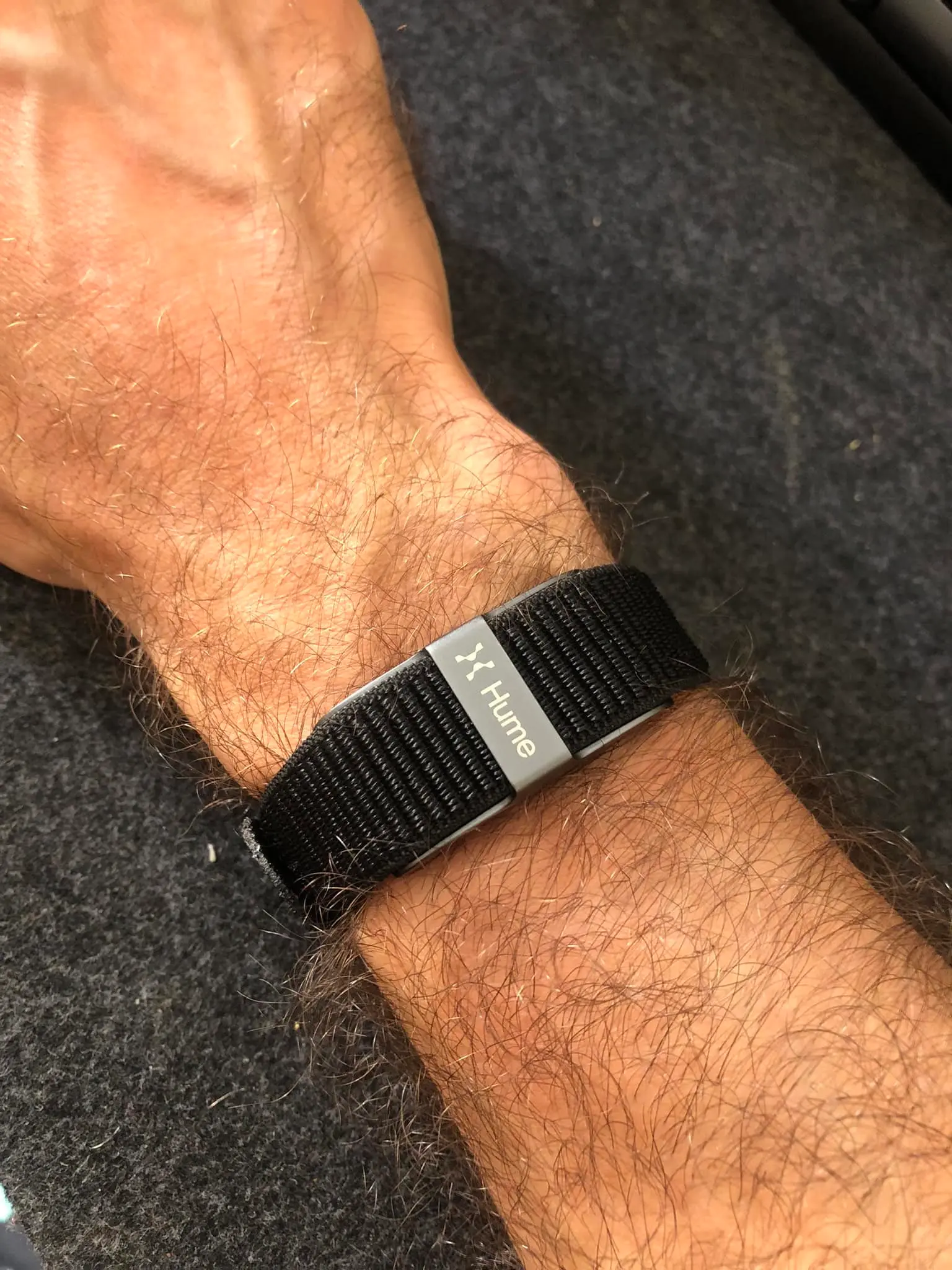
Spec sheets and side-by-side tables are useful, but they only tell you part of the upgrade story. The other part is what actually happens when you live with a device on your wrist for months on end. I have worn the original Hume Band for a full year of daily use, and that year taught me four things that directly affect whether the 2.0 upgrade is worth it for you.
First lesson: data gaps are quietly expensive
In the first few weeks, I treated the v1’s 7-day charging routine as a non-issue. By month two, I started noticing that my Metabolic Momentum scoring became less responsive to the changes I was actually making (less alcohol, earlier bedtimes, more morning walks). When I traced it back, the cause was obvious: every charging cycle created a 90-minute to 2-hour data gap, and the rolling-window algorithm was compensating for those gaps by smoothing over the very signal I was trying to track. As a physiotherapist, I know how much continuity matters in physiological data. Doubling the battery is not a quality-of-life tweak. It is the difference between a tracker that sees your real life and a tracker that sees your life with regular interruptions, and over twelve months of wear those interruptions add up to a meaningful chunk of missing baseline.
Second lesson: comfort dictates compliance
The SuperKnit strap on the v1 is genuinely good. Compared to silicone bands, it is a clear win. But around the two-month mark, I started taking the band off at night because the strap firmness was interfering with how I sleep. Sleep is the highest-leverage recovery variable in any longevity protocol, and a tracker that you take off for the 8 hours that matter most is worse than no tracker at all. I eventually sourced a third-party Amazon strap to make the v1 livable 24/7, and even with that workaround it was never quite right. After a full year of strap experimentation, the UltraLux fabric on the 2.0 is exactly what should have shipped on the v1 from day one.
Third lesson: long-term reliability is the real test
One of the things you only learn from a full year of wear is how the device ages. Battery degradation, app stability, firmware update cadence, sensor reliability across seasonal humidity changes, none of these show up in a month-long review. After twelve months, my v1’s battery still holds close to its original 7-day rating, the Hume Health app has received steady improvements without breaking my historical data, and the sensor module has been reliable through everything from Spanish summer humidity to winter showers. That long-term reliability is what gives me confidence to recommend the 2.0: if Hume Health treated the v1 this well over a year, the 2.0 will get the same level of long-term support.
Fourth lesson: cardiovascular metrics are where this category goes next
By the end of the year, I had a real wish list for what the next version of the device should add. Blood pressure tracking was at the top. Not as a cuff replacement, but as a longitudinal lens on cardiovascular risk that you cannot get any other way. The Hume Band 2.0 ships exactly that feature, and from a physiotherapist’s perspective, this is the feature that promotes the Hume Band from “interesting longevity wearable” to “tool I would actually recommend to a 40-year-old patient worried about their cardiovascular trajectory.” It is the single feature most likely to make the 2.0 worth the upgrade for the right person.
Hume Band 2.0 vs 1.0: Three v1 Owner Profiles and the Right Upgrade Answer for Each
Most upgrade-decision content treats every v1 owner as the same person. They are not. Here are the three real-world v1 owner profiles I see most often, with an honest verdict for each.
The Burned-Out Optimizer
You bought the v1 because you were tracking your way out of a burnout cycle. You wear it 24/7, you check your HRV every morning, and you have built actual habits around what the device tells you. You have noticed the v1’s Metabolic Momentum scoring drifts on charge days, and you have wished the band could see your blood pressure on the days you can feel it in your chest.
Verdict: the 2.0 is built for you. The doubled battery removes your data gaps, Blood Pressure Insights closes the cardiovascular gap, and the cleaner signal processing means your daily AI nudges will finally be confident and specific. This is the persona where the upgrade pays back fastest.
The Cardio-Cautious Adult 35+
You are over 35, cardiovascular health is starting to matter to you in a way it did not at 25, and you bought the v1 to get out ahead of the silent biomarker shifts that show up before any clinical diagnosis. You like the Heart Resilience score, you take Pace of Aging seriously, and a separate cuff blood pressure monitor has been on your “I should buy this” list for months.
Verdict: skip the cuff, upgrade to the 2.0. Blood Pressure Insights alone justifies the move at your life stage, and the cleaner signal processing makes every other cardiovascular metric (Heart Resilience, Biological Age, Chronic Illness Detection) more trustworthy at the moment in life when you most need to trust them.
The Casual Wearer
You wear the v1 most days, you check the app once or twice a week, and you mostly want a directional sense of how your habits are going. You do not have a specific cardiovascular concern, you have not built rigid daily rituals around the data, and you are comfortable with the SuperKnit strap.
Verdict: the 2.0 is genuinely better, but the upgrade math depends on price. If you are a Hume Premium subscriber, your free upgrade-every-2-years benefit makes this an obvious yes (you essentially get the 2.0 included). If you are not subscribed and you are happy with the v1, waiting 6 to 12 months until you have a specific reason to upgrade is a defensible choice.
The Recent v1 Buyer (Within 3 Months)
You bought the v1 less than 3 months ago. You are still in your initial baseline calibration window. The device is just starting to deliver real insights, and you have not yet had the time to develop strong opinions about its limitations.
Verdict: keep your v1 for now. Finish the baseline period, build the habits, develop your real opinions about what works and what does not. If the limitations the 2.0 fixes (battery gaps, strap comfort, blood pressure visibility) end up being your specific pain points, upgrade in 6 to 9 months. If you adapt around them, save the upgrade money for a 3.0 cycle.
If You Subscribe to Hume Premium, the Upgrade Is Essentially Free
There is one piece of the upgrade calculation almost every comparison page misses, and it changes the numbers significantly. The Hume Premium subscription ($8.99 per month, fully optional) includes a benefit most wearable brands do not offer: a free Hume Band upgrade every 2 years.
If you are already a Hume Premium subscriber, this benefit means the Hume Band 2.0 is effectively included in your existing subscription. You are not paying $356 (or $199 with the discount code). You are paying the same $8.99 per month you were already paying, and the 2.0 ships to you as part of your subscription value.
If you are not currently a Hume Premium subscriber and you have been weighing whether the AI coaching layer is worth $8.99 per month, this benefit changes the math. You are not just paying for AI coaching, you are pre-paying for your future device upgrades. For a v1 owner who plans to stay in the Hume ecosystem long-term, signing up for Premium and getting the 2.0 as part of the subscription is the cleanest economic move.
For a v1 owner who never wants a subscription, the standard $199 (with code MYREVIEWABOUT) upgrade still applies, and the value proposition of the 2.0 hardware stands on its own. But the math heavily rewards Premium subscribers, and that asymmetry is worth knowing before you make the upgrade decision.
Hume Band 2.0 Upgrade Pricing
The Hume Band 2.0 pricing breaks down as follows. The retail price is $356 USD, the current sale brings it down to $249 USD, and using code MYREVIEWABOUT at checkout adds an additional 20% discount on top of the sale price, bringing the final cost to $199 USD. That is a $156 saving off the original retail.
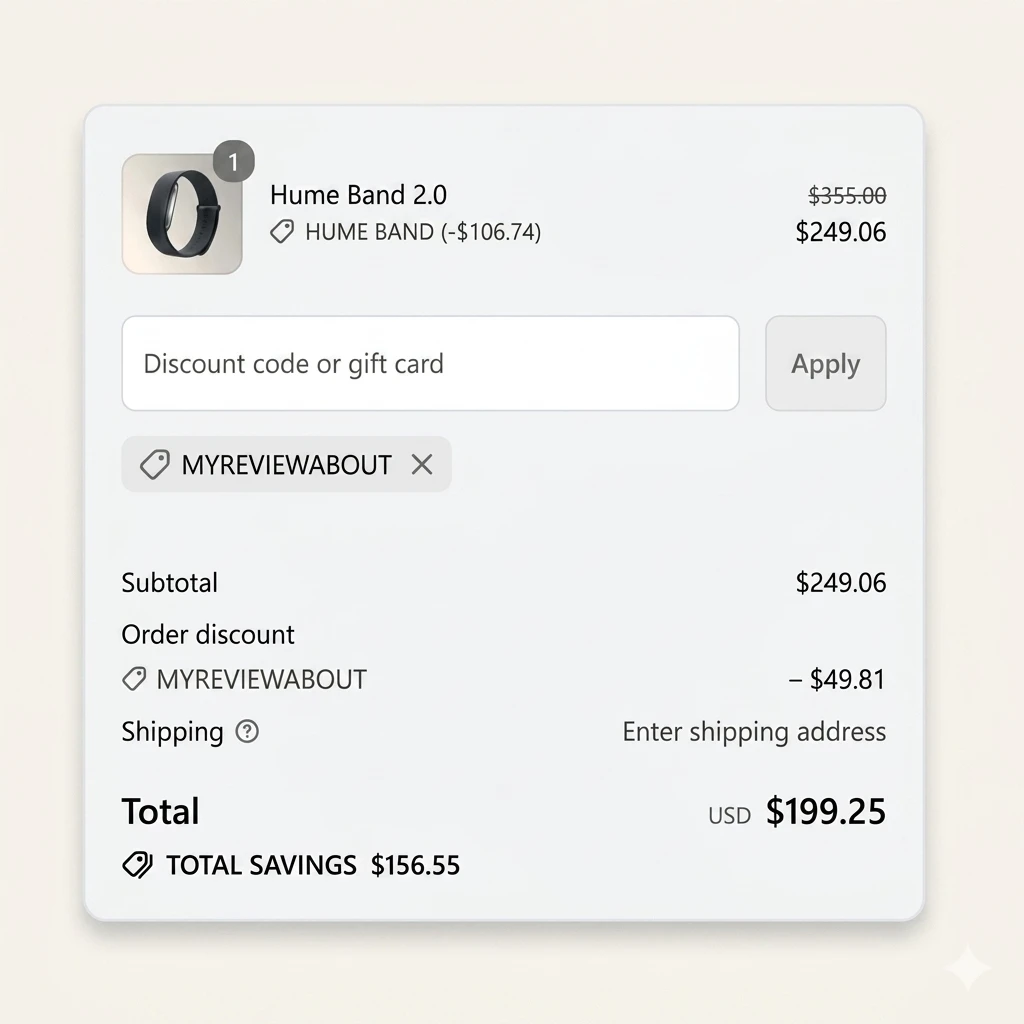
Free worldwide shipping is included on orders over $20, the 45-day no-questions-asked return policy applies even to used and opened products, and each Hume Band 2.0 ships with a 1-year warranty included (extendable to 10 years for $35). If the 2.0 turns out not to be the right move for you, you have a month and a half to test it on your wrist before committing.
Hume Band 2.0 vs 1.0 Upgrade Questions, Answered
1. Will my v1 data carry over to the Hume Band 2.0?
Yes. Your Hume Health app, your historical biomarker data, your Biological Age trend, your sleep architecture history, all of it is tied to your Hume Health account, not to the device. When you switch from the v1 to the 2.0, your data continues seamlessly. The 2.0 just starts logging new data into the same timeline.
2. Can I keep wearing my v1 while I get used to the 2.0?
You can keep the v1 as a backup, but you only pair one device at a time to the Hume Health app. Most v1 owners upgrade and sell or gift the v1 to a family member who can pair it to their own Hume Health account. The original Hume Band still works perfectly, Hume continues to support it with firmware updates, and a partner or family member can use it independently with their own data baseline.
3. Should I sell my Hume Band 1.0 after upgrading?
Worth considering. The v1 has resale value, and if you have someone in your life who is curious about longevity tracking but not yet ready to spend $200+ on a new device, gifting or selling them your v1 is a way to expand the Hume Health ecosystem in your household. Just remember to factory-reset the v1 from the Hume Health app before handing it over, so the new user can pair it to their own account.
4. Does the Hume Premium subscription transfer to the 2.0 automatically?
Yes. Your Hume Premium subscription is tied to your Hume Health account, not the device. When you switch to the 2.0, your subscription continues without interruption, and your free band upgrade every 2 years benefit applies to your next future upgrade (whenever Hume releases a 3.0 or beyond).
5. Is the UltraLux strap compatible with my v1, or do I need the full 2.0 to get it?
The UltraLux strap is designed specifically for the 2.0’s sensor module form factor. While the v1 and 2.0 module footprints look similar, the strap attachment system is not cross-compatible, so you cannot retrofit an UltraLux strap to your v1. The strap upgrade is part of the 2.0 hardware package.
6. What if I just want the cleaner signal processing without buying new hardware?
The improved signal processing on the 2.0 is a combination of firmware and processing algorithms tuned to the 2.0’s hardware. The v1 continues to receive its own firmware updates and improvements, but the v2-tier signal cleanup is not retroactively available on v1 hardware. If signal cleanup is your primary reason for upgrading, you need the 2.0 hardware to access it.
Final Verdict: Is the Hume Band 2.0 vs 1.0 Upgrade Actually Worth It?

For most v1 owners, the Hume Band 2.0 is worth the upgrade. The doubled battery removes the data gaps that quietly degrade your trend quality. The UltraLux strap fixes the comfort issue that pushed too many v1 owners to take the band off at night. Blood Pressure Insights closes the cardiovascular gap that the v1 always had. And the cleaner signal processing makes every existing metric (Chronic Illness Detection, Pace of Aging, Heart Resilience, Biological Age) quietly smarter without the marketing slide saying it.
The few v1 owners who should skip the upgrade are clear: people who bought the v1 less than 3 months ago and have not finished their baseline calibration, people who rarely wear the device anyway, and people who have no specific cardiovascular interest. For everyone else, particularly Hume Premium subscribers whose subscription benefit makes the 2.0 essentially included, the upgrade is one of the cleaner buy decisions in the wearable category right now.
If you are ready to upgrade, the current pricing makes this a strong moment to act. $199 with code MYREVIEWABOUT, free worldwide shipping, 45-day return policy, 1-year warranty extendable to 10 years for $35. The risk of trying the 2.0 is minimal, and if you discover the upgrade was not what you needed, you have a month and a half to return it.
If you have not read it yet, the full Hume Band 2.0 review covers everything the 2.0 actually does (the metrics, the science, the day-to-day use), and the Hume Band 2.0 hub is the central page if you want the bigger picture of the device beyond this Hume Band 2.0 vs 1.0 upgrade decision.